
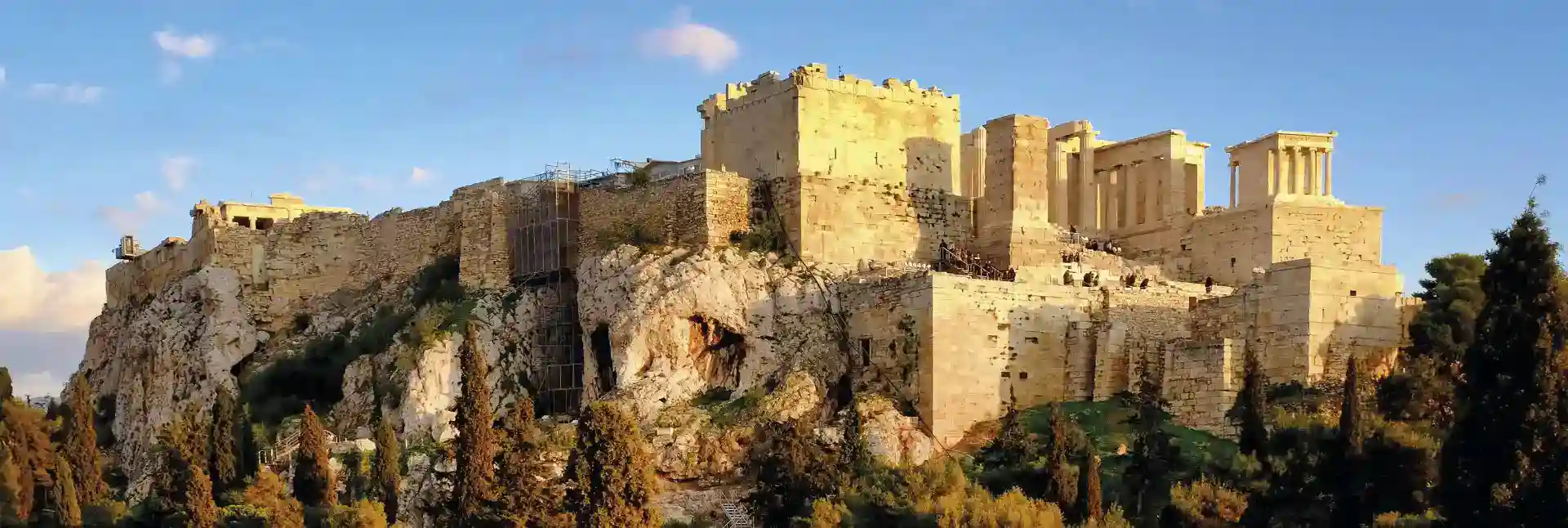
What is special about the Acropolis of Athens? Keys to understanding its importance
When people ask us what is special about the Acropolis of Athens, we actually believe it would be more appropriate to ask what is not special about this archaeological site. We are not just talking about a hill with ancient temples; it is where ideas that transformed the world were born: democracy, rational philosophy, theatre as a political and social tool, and a conception of art based on harmony, proportion, and ideal beauty.
For this reason, we would like to provide more context about the importance of the Acropolis, not only as a historical complex thanks to its monuments, but also as the cradle of Western civilization. Let’s begin!
Athens and its legacy in Ancient Greece
To understand what is special about the Acropolis of Athens, we must place ourselves in the 5th century BC, the so-called Age of Pericles. Athens was not simply another city-state; it was the political, cultural, and artistic epicenter of the Greek world.
The cradle of democracy
Athens developed the first known democratic system, although it was very limited, as only free men born in the city could participate. This represented a radical break with the oligarchic and tyrannical systems that had previously dominated. The idea that power should belong to citizens marked a turning point in political history.
Philosophy and critical thinking
Athens was home to Socrates, Plato, and Aristotle. In its streets, ethical, political, and metaphysical questions were debated—issues that are still studied today in universities around the world.
The Greek ideal of kalokagathía (the union of beauty and virtue) influenced both architecture and public life. The harmony we see in the Parthenon is not accidental; it reflects a philosophical conception of order and proportion as a reflection of universal balance.
Art, theatre, and collective awareness
At the foot of the hill lies the Theatre of Dionysus, where the tragedies of Aeschylus, Sophocles, and Euripides were first performed. Theatre was not merely entertainment; it was a tool for political and moral reflection.
Dramatic performances addressed themes such as justice, power, and war. Therefore, if you ask what is special about the Acropolis of Athens, it was also a precursor to the use of art as a political and cultural instrument, encouraging citizens to think critically.
The symbol after the Persian Wars
After the Persian destruction in 480 BC, Athens decided to rebuild the Acropolis with an unprecedented monumental ambition. Under the leadership of Pericles, the architectural program not only restored what had been lost, but elevated the city to an artistic level never seen before.
This action was deeply political: Athens had not only survived, but proclaimed its cultural and military supremacy in the Greek world. That is why, when we look at the Acropolis today, we are also witnessing a statement of power.
The Acropolis as a unique monumental complex
Answering the question of what is special about the Acropolis of Athens also means reviewing each of its buildings.
The Propylaea: the monumental entrance
Access to the hill is through the Propylaea, a monumental gateway designed by Mnesicles. From the very first moment, visitors understood that they were entering a sacred and exceptional space.
The architecture of the Propylaea combines functionality and solemnity. The transition between the profane and the sacred is expressed through Doric columns and refined interiors that prepare visitors for what lies ahead.
The Temple of Athena Nike
The Temple of Athena Nike celebrates victory. Its strategic position recalls the wars against Persia and the importance of divine protection.
The frieze decorating it depicts scenes of war, but also shows a sculptural delicacy that reflects Athenian artistic refinement. The famous depiction of the goddess adjusting her sandal is a masterful example of naturalism.
The Parthenon: harmony and perfection
The Parthenon, dedicated to Athena Parthenos, was designed by Ictinus and Callicrates and decorated sculpturally under the direction of Phidias.
Its size and level of preservation make it magnificent, but its technical perfection makes this complex truly impressive when visited in person. It includes almost imperceptible optical corrections: columns slightly inclined inward, a curved stylobate (a curved base so that it appears perfectly straight), subtle variations that create the illusion of absolute straightness.
The Panathenaic frieze and the metopes depicted foundational myths and celebrated Athenian identity. Therefore, the temple was not only religious but also a declaration of cultural superiority.
The best way to understand all these details (and many more that could be explained) is to discover the Acropolis of Athens through a guided visit, exploring each space with an expert and contextual perspective that helps you understand everything you see in an engaging way.
The Erechtheion and the Caryatids
The Erechtheion is one of the most symbolically complex buildings, as it was not only a place where multiple deities were worshipped, but also heroes. Among them were Poseidon and the mythical king Erechtheus.
Its most distinctive feature, and what makes it famous, are the Caryatids: six female figures that replace traditional columns. These sculptures represent the fusion between structure and art.
The Caryatids convey elegance and solemnity. Every fold of their garments, every posture and slightly different expression demonstrates the virtuosity of the sculptors. As a fact, the ones you see on the Acropolis are not the originals; these are preserved in the Acropolis Museum. The ones on the building today are replicas.
The Theatre of Dionysus and the Odeon
On the slopes of the Acropolis you will find the Theatre of Dionysus, the first stone theatre in the Greek world and the foundation of Western theatre.
Very close to it stands the Odeon of Herodes Atticus, built in the Roman period, which still today hosts concerts and performances.
Now that we have explored its historical context and its monuments, you probably have a clearer idea of what makes the Acropolis of Athens so special. Doesn’t it make you want to see it in person? Discover the Acropolis with an expert perspective and book your Parthenon ticket for a visit that will turn a simple look into an unforgettable memory.