
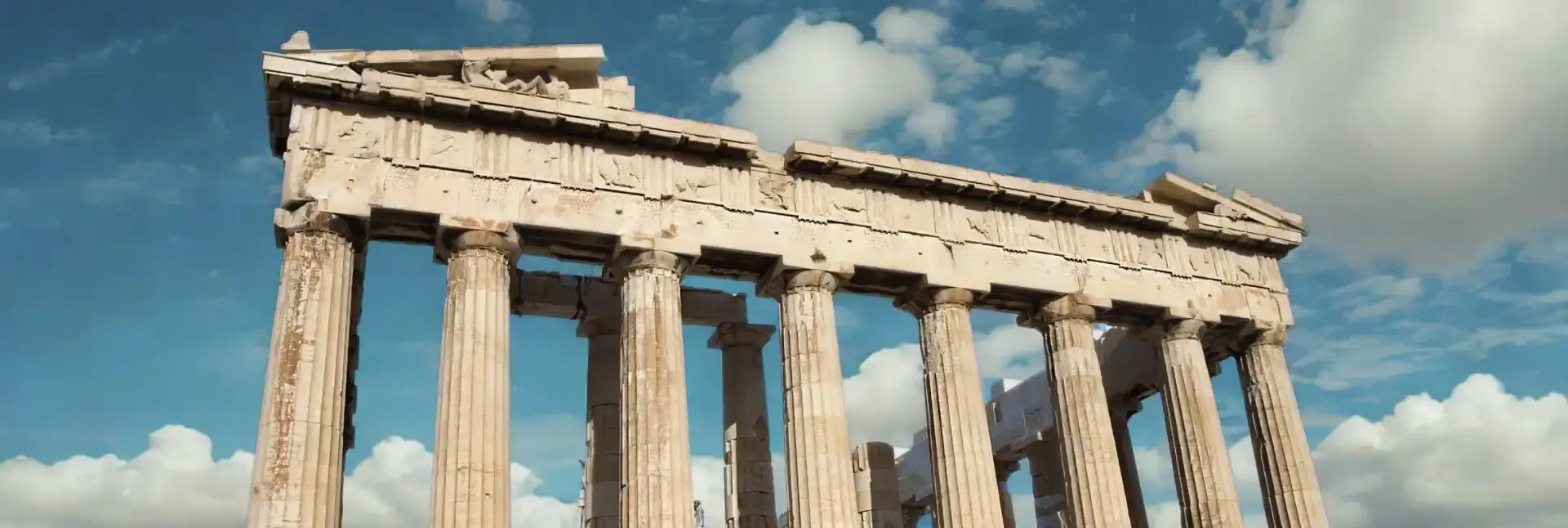
Who ordered the construction of the Parthenon? History of the monument
When we look at the top of the hill and contemplate the Acropolis, it is very common to find ourselves wondering how it could have been built in ancient times — and for good reason! If you also inevitably ask yourself who ordered the construction of the Parthenon and why this building became the most powerful symbol of Greek civilization, you are in the right place. Join us on this journey through the true history of the Parthenon.
Who ordered the construction of the Parthenon and in what historical context
The direct answer to the question of who ordered the construction of the Parthenon is clear: it was the Athenian statesman Pericles who promoted its construction in the 5th century BC.
We must place ourselves in the year 447 BC, during the height of Classical Athens. After the Greco-Persian Wars, the city had been devastated. The earlier temples of the Acropolis were destroyed, and Athenian pride had been deeply wounded.
Pericles, a political leader of enormous influence, decided to turn that defeat into a historic opportunity. His ambition was to transform Athens into the cultural, artistic and political center of the Greek world, and the Parthenon was meant to be the visible symbol of that power.
It is important to understand that the temple was not only a religious building. It was also a political statement. Athens led the Delian League, a military alliance of Greek city-states. Part of the league’s funds were used to finance the construction program on the Acropolis, including the Parthenon. This decision sparked criticism at the time, but it also reinforced Athenian hegemony.
Why the Parthenon was built
The Parthenon was conceived as a temple dedicated to Athena Parthenos, meaning Athena the Virgin, the protective goddess of the city. However, its purpose went far beyond religion.
First of all, it had a profound spiritual meaning. Athena was considered the protector of Athens. The temple housed an impressive chryselephantine statue (made of gold and ivory) representing the goddess in all her splendor. Devotion to her was an essential part of Athenian identity.
Secondly, the Parthenon symbolized victory over the Persians. Many of its reliefs depicted mythological scenes referring to the triumph of order over chaos, a direct metaphor for the Greek victory against the eastern invaders.
Thirdly, the building had an economic function. Inside the temple part of the treasury of the Delian League was safeguarded, reinforcing Athens’ role as the dominant power.
Ultimately, the Parthenon was built to honor the goddess, celebrate Athenian supremacy and project to the world the image of a cultured, powerful and refined city, something that we can still perceive today when looking at it.
The architects of the Parthenon: Ictinus and Callicrates
Another essential question when discussing the history of the Parthenon of Athens is who designed this masterpiece.
The architects responsible were Ictinus and Callicrates, under the artistic supervision of an even more famous figure: Phidias.
Ictinus was the principal architect and the technical mind behind the project. Callicrates collaborated closely in both design and execution. Together they created an apparently perfect Doric temple, although this perfection hides complex optical refinements that reveal a sophisticated understanding of visual perception.
Nothing in the Parthenon is completely straight. The columns have a slight curvature known as entasis. The stylobate (the base on which the columns stand) is slightly curved. Even the columns lean subtly inward.
These details are not mistakes. They are visual corrections designed to avoid the optical illusion of concavity that would occur if all lines were perfectly straight. This level of architectural refinement makes the Parthenon a technically revolutionary work for its time.
The sculptures and artistic supervision: the genius of Phidias
If the architectural design was exceptional, the sculptures that adorned the monument elevated it to an almost divine dimension — which, after all, was precisely the intention.
The artistic director responsible was Phidias, one of the most important sculptors of classical antiquity.
Phidias created the monumental statue of Athena Parthenos that stood inside the temple. This sculpture, now lost but historically documented, measured approximately 12 meters in height and was made of gold and ivory (chryselephantine) on a wooden structure.
In addition to this imposing statue, the decorative program of the Parthenon included:
- The pediments, depicting the birth of Athena and the contest between Athena and Poseidon for the patronage of Attica.
- The metopes, showing mythological battles such as the Centauromachy and the Amazonomachy.
- The inner frieze, an extraordinary work representing the Panathenaic procession, an important Athenian religious festival.
- This sculptural ensemble had not only immense artistic value but also symbolic significance. It reflected Athenian identity, mythology and worldview.
Phidias succeeded in giving the figures movement, naturalism and emotional expression — something revolutionary for the period. His work marked a turning point in the history of Western art.
What architectural details make the Parthenon unique
The Parthenon is an octastyle Doric temple, meaning it has eight columns on its main façade. It is built primarily from Pentelic marble, an extraordinarily high-quality material that still reflects light spectacularly today.
The building measures approximately 69.5 meters in length and 30.9 meters in width. It features 46 exterior columns surrounding the structure. Yet beyond the numbers, what truly impresses visitors is the experience of walking around the temple and perceiving the harmony with which it was designed.
Visiting it with historical context completely transforms the experience. That is why, if you are planning your trip and wish to understand these details in depth, we invite you to experience it with us. Our team of experts will help you discover every secret of the monument and interpret its symbolism with historical rigor. Book your Parthenon ticket and join us on a tour that will change the way you look at the Acropolis.