
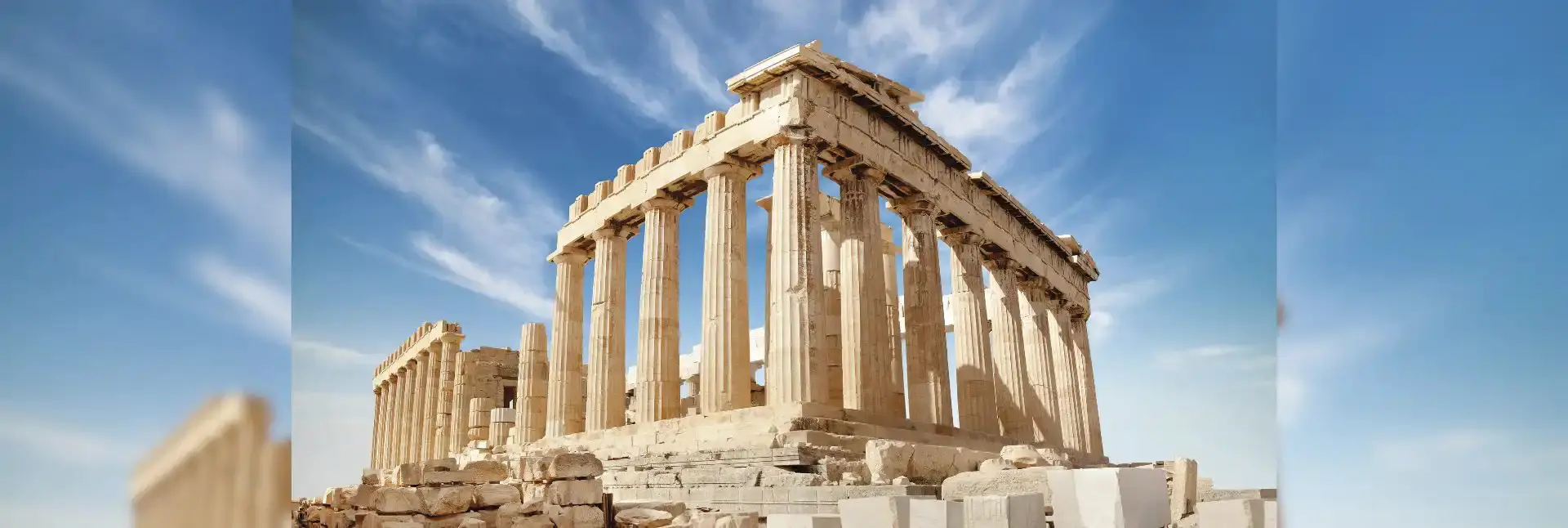
Why is it called the Parthenon? Origin and meaning of the name of the Parthenon of Athens
Visiting the Acropolis is an overwhelming experience for many, as observing the grandeur of the different monuments that compose it is truly impressive. Many questions begin to arise as we walk through this extremely important archaeological site, but one in particular is frequently repeated by those who accompany us: why is it called the Parthenon? That is why today we have set out to answer this question for everyone. Join us on a journey back in time!
What “Parthenon” literally means: the etymological origin of the term
To understand why it is called the Parthenon, we must look to Ancient Greek. The term Παρθενών (Parthenṓn) comes from the word παρθένος (parthénos), which means “virgin” or “maiden”. This root was used in Ancient Greece to refer to young women who had not yet married.
The suffix -ōn in Greek can indicate a place associated with something specific. Therefore, “Parthenon” can literally be translated as “the place of the virgin” or “the chamber of the virgin”. This nuance is neither accidental nor poetic: it is closely connected to the divinity to whom the temple was dedicated.
Originally, the name did not necessarily designate the entire building as we understand it today. Some scholars suggest that it initially referred to a specific chamber within the temple, probably the western room where the treasury of the Delian League was kept. Over time, the term expanded to refer to the entire temple complex that we now know as the Parthenon of Athens.
This linguistic detail reveals something essential: the name does not simply describe an architectural structure but rather a divine quality. When we ask why it is called the Parthenon, the answer begins in the Greek language and leads us directly to the religious heart of the city.
Why the Parthenon was dedicated to Athena Parthenos
The key to understanding why it is called the Parthenon lies in the figure of Athena Parthenos, meaning Athena the Virgin. Athena was the protective goddess of the city of Athens, a symbol of wisdom, military strategy, craftsmanship, and civilization—precisely everything we associate today with ancient Greece!
According to mythology, Athena was born from the head of Zeus, already fully grown and completely armed. This unusual origin reinforced her independent and virginal character. Unlike many other Olympian deities, Athena never married nor had children. Her condition as parthénos was a fundamental part of her divine identity.
The temple built between 447 and 432 BC, under the leadership of Pericles, was conceived as a monumental tribute to the protective goddess of the polis. Inside stood an impressive chryselephantine statue (made of gold and ivory) sculpted by Phidias, representing Athena Parthenos in all her splendor.
Thus, the building took its name from this specific title of the goddess: the Virgin. It was not simply the temple of Athena, but the sanctuary dedicated to her virginal and protective nature. Therefore, when we ask why it is called the Parthenon, we must understand that the name is a direct tribute to the sacred identity of the goddess.
During our guided tours we often pause at this point, because understanding the religious dedication of the temple completely transforms the visitor’s experience. It is not only about admiring perfectly proportioned Doric columns, but about understanding the deep relationship between architecture, myth, power, and the worldview of the time in which it was built.
The symbolic importance of the Parthenon in classical Athens
The Parthenon of Athens was not only a religious temple. Above all, it was a political and cultural statement. Its construction coincided with the peak of Athenian democracy and the leadership of the city in the Greek world after the Persian Wars. These wars may sound more familiar if we mention the Battle of Thermopylae, known thanks to its famous cinematic representation.
Therefore, the feat of constructing a building of such magnitude at the top of the Acropolis was not an innocent act. It was a declaration of supremacy. Athens presented itself as the cultural beacon of Greece, and the Parthenon was its visible symbol.
In this context, understanding why it is called the Parthenon also means recognizing that the name had an ideological dimension. The virginity of Athena symbolized purity, independence, and moral strength. The city identified itself with these values. Athens was, like its goddess, invincible, wise, and self-sufficient.
The reliefs of the frieze and the metopes depicted mythological scenes representing the struggle between order and chaos, between civilization and barbarism. The message was clear: Athens, protected by Athena Parthenos, embodied order and reason.
In this way, the name “Parthenon” did not only describe the goddess but also reinforced the collective identity of the polis. Every time we pronounce that name, we evoke an ideal of city, culture, and balance.
The historical evolution of the name and its permanence over time
Another interesting aspect when analyzing why it is called the Parthenon is observing how the name has survived through the centuries, even as the building changed its function.
During the Byzantine period, the temple was transformed into a Christian church dedicated to the Virgin Mary. Later, under Ottoman rule, it became a mosque. In each era, the building acquired new religious and cultural meanings.
However, the name “Parthenon” persisted. This demonstrates the symbolic strength of the original term. Even though the worship of Athena disappeared, the classical name remained as a historical reference.
Today, millions of visitors walk through the Acropolis every year and ask why it is called the Parthenon. The name has transcended religions and civilizations, becoming a universal icon of cultural heritage.
If you are planning your trip, we recommend organizing your Parthenon ticket in advance, as demand remains high throughout the year. Knowing the meaning of its name before passing through its columns will make your experience much richer.
If you would like to experience the Parthenon of Athens in a deep and personalized way, we invite you to book a tour with us. We can help you enjoy your visit and understand every historical and artistic detail of the monument. Book your Parthenon ticket and discover Athens through the eyes of an expert.